

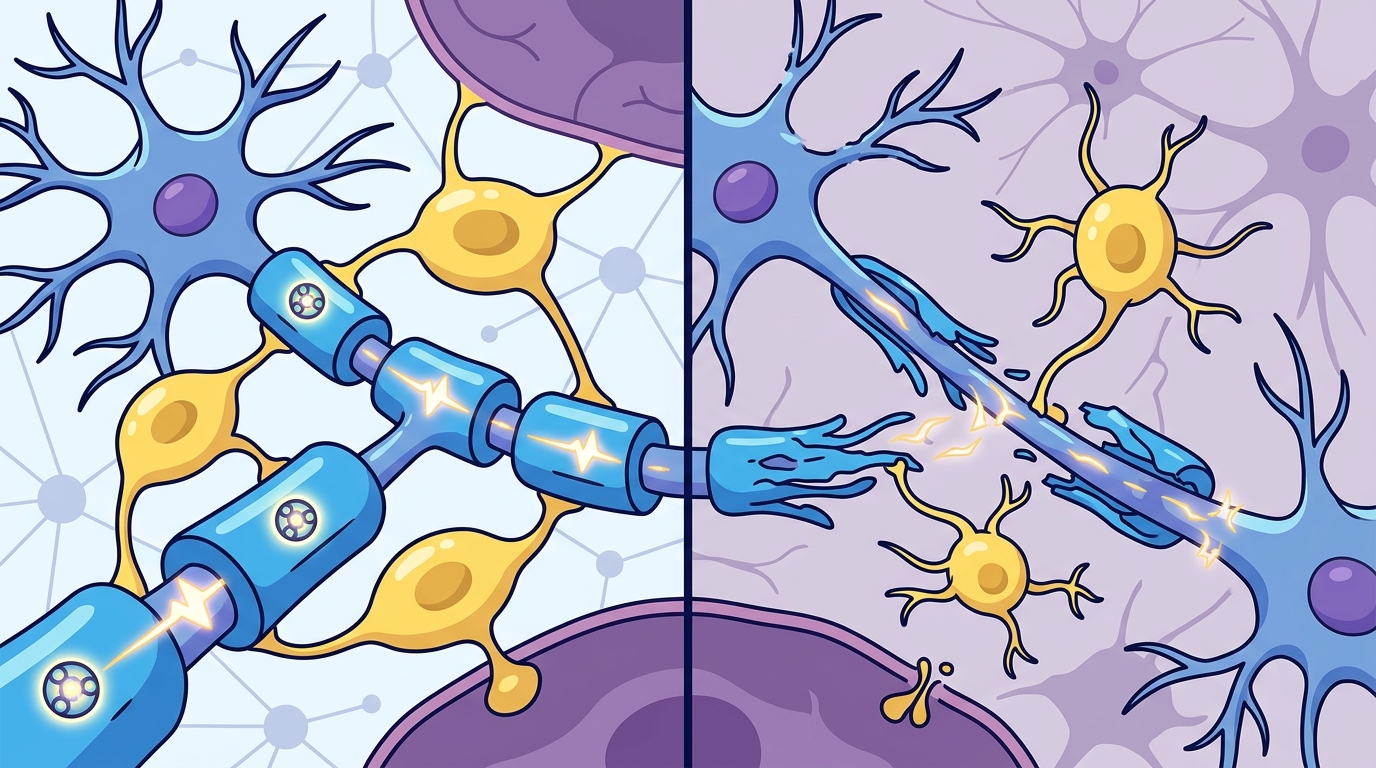
Your neurons fire signals and your glial cells keep them insulated, fed, and protected. Both cell types depend heavily on plasmalogens, a class of phospholipids that make up roughly 15 to 20 percent of the phospholipid content in human tissues. When plasmalogen levels fall, neurons lose synaptic efficiency while glial cells struggle to maintain the myelin sheaths that speed electrical transmission. The result is a two-front breakdown: slower thinking and weaker structural support. This tutorial introduces a neuron-glia recovery framework, a paired strategy that addresses both gray matter performance and white matter integrity so you can rebuild cognitive function from both sides of the equation.
Why Cognitive Decline Is a Dual-Cell Problem
Most discussions about brain health focus on neurons alone. But glial cells, including oligodendrocytes and astrocytes, outnumber neurons and perform essential housekeeping duties such as building myelin and clearing waste. Research published in Brain Research Bulletin shows that plasmalogen deficiency disrupts myelin structure, synaptic neurotransmission, and intracellular signaling simultaneously.
A plasmalogen is a glycerophospholipid distinguished by a vinyl-ether bond at the sn-1 position, which gives it unique antioxidant capacity. Because different plasmalogen species concentrate in different cell types, a single supplement cannot address the full picture. Omega-3 (DHA) plasmalogens concentrate in neuronal gray matter, while omega-9 (oleic acid) plasmalogens dominate glial white matter. Effective recovery requires feeding both pools.
Recognizing the Signs of Low Plasmalogens
Plasmalogen deficiency does not announce itself with a single dramatic symptom. Instead, it produces a cluster of subtle shifts that worsen over time. Watch for these patterns:
- Persistent brain fog or difficulty sustaining focus
- Slower word retrieval and recall lapses
- Reduced exercise tolerance or unexplained fatigue
- Sleep fragmentation or declining sleep quality
- Balance and coordination changes
A 2023 hypothesis paper in Brain Research Bulletin identified plasmalogen depletion as a shared biological hallmark of both ME/CFS and post-COVID-19 syndrome, conditions defined largely by cognitive fog and fatigue. If these symptoms sound familiar, objective measurement is the logical next step.
Step 1: Quantify Your Deficiency With Blood Testing
Guessing at your plasmalogen status is inefficient. The ProdromeScan blood test reports over 40 biomarkers, including current plasmalogen levels and your body's capacity to produce them via peroxisomal pathways. Results arrive within 10 to 14 business days after the lab receives your sample.
What the Numbers Tell You
A pilot study published in CMAJ found that Alzheimer's patients whose serum plasmalogen levels were at or below 75 percent of age-matched controls experienced significantly greater cognitive decline over one year. Patients with normal baseline levels showed no measurable decline. Knowing your number gives you a concrete target.
Working With a Practitioner
ProdromeScan is available through health professionals registered with Prodrome. The Prodrome FAQ page recommends consulting a qualified provider to interpret results and design an individualized protocol.
Step 2: Match Supplementation to Cell Type
This is where the neuron-glia framework becomes actionable. Instead of choosing one supplement, you pair two formulations that target different compartments of the brain.
| Feature | ProdromeNeuro | ProdromeGlia |
|---|---|---|
| Plasmalogen type | Omega-3 (DHA) precursor | Omega-9 (Oleic acid) precursor |
| Primary target cells | Neurons (gray matter synapses) | Glial cells (white matter, myelin) |
| Key function supported | Synaptic signaling, cognition | Myelin integrity, nerve insulation |
| Suggested timing | Morning (stimulating effect) | Evening (calming effect) |
| Standard daily dose | 2 softgels (900 mg) | 2 softgels (900 mg) |
| Loading dose option | 4-8 softgels for 1-3 months | 4-8 softgels for 1-3 months |
A plasmalogen precursor is a bioavailable compound engineered to bypass digestive degradation and convert into plasmalogens once inside your cells. Diet alone cannot restore levels efficiently because intact plasmalogens break down before absorption. Dr. Dayan Goodenowe, founder of Prodrome Sciences, developed the first synthetically pure plasmalogen precursors to solve this bioavailability problem.
Step 3: Optimize Timing and Bioavailability
Morning and Evening Rhythm
ProdromeNeuro in the morning supports daytime alertness and synaptic performance. ProdromeGlia in the evening complements natural repair cycles during sleep. Both can be taken with or without food and alongside other supplements.
The Loading Phase
A loading dose is a temporarily elevated intake designed to accelerate repletion. For individuals with confirmed low levels, practitioners often suggest 4 to 8 softgels daily for one to three months before tapering to the maintenance dose. Always follow the guidance of your healthcare provider.
Absorption Tips
If using the oil format, mix it with a beverage other than water to prevent separation. Taking plasmalogens alongside a healthy fat source may further support uptake.
Step 4: Reinforce With Lifestyle Levers
Supplementation restores supply, but lifestyle habits reduce the demand placed on your plasmalogen reserves by limiting oxidative stress and inflammation.
Exercise
Moderate aerobic activity improves peroxisomal function, the organelle pathway responsible for plasmalogen synthesis. Even 150 minutes per week of brisk walking has measurable effects on brain lipid metabolism.
Anti-Inflammatory Nutrition
Chronic inflammation accelerates plasmalogen degradation. A Mediterranean-style diet rich in polyphenols, omega-3 fatty acids, and cruciferous vegetables reduces the oxidative burden on your vinyl-ether bonds. Prodrome also offers Prodrome BDMC, a curcuminoid supplement, for additional anti-inflammatory support.
Sleep Quality
The glymphatic system, your brain's waste-clearance network, operates most efficiently during deep sleep. Poor sleep quality compounds plasmalogen loss by increasing neuroinflammation and reducing repair time.
Key Takeaways
- Plasmalogen deficiency undermines both neuronal synapses and glial myelin, creating a dual-cell cognitive problem.
- Blood testing through ProdromeScan provides objective measurement of your plasmalogen status and biosynthetic capacity.
- Effective recovery pairs an omega-3 precursor (ProdromeNeuro) for gray matter with an omega-9 precursor (ProdromeGlia) for white matter.
- Morning and evening dosing aligns with each formula's natural stimulatory or calming profile.
- A loading dose of 4-8 softgels daily for 1-3 months can accelerate initial repletion when supervised by a practitioner.
- Lifestyle factors including exercise, anti-inflammatory nutrition, and quality sleep protect plasmalogen reserves from oxidative depletion.
- Patients with serum plasmalogen levels below 75 percent of age-matched norms are at the highest risk for measurable cognitive decline.
Frequently Asked Questions
What is a plasmalogen?
A plasmalogen is a type of glycerophospholipid characterized by a vinyl-ether bond at the sn-1 position of its glycerol backbone. Plasmalogens are found in high concentrations in the brain, heart, lungs, eyes, and kidneys, where they support membrane structure, antioxidant defense, and cell signaling.
How do I know if I have a plasmalogen deficiency?
The most reliable method is a blood test such as the ProdromeScan, which measures plasmalogen levels alongside over 40 related biomarkers. Symptoms like persistent brain fog, memory lapses, and fatigue may suggest low levels but are not diagnostic on their own.
Can I get enough plasmalogens from food?
No. While small amounts of plasmalogens exist in shellfish and organ meats, intact plasmalogens are largely broken down during digestion before they can be absorbed. Synthetically designed plasmalogen precursors bypass this limitation.
What is the difference between ProdromeNeuro and ProdromeGlia?
ProdromeNeuro delivers an omega-3 (DHA) plasmalogen precursor targeting neuronal gray matter and synaptic function. ProdromeGlia delivers an omega-9 (oleic acid) plasmalogen precursor targeting glial white matter and myelin structure. Many users take both as a complementary pair.
How long before I notice results?
Individual responses vary. Some users report improvements in sleep, focus, and energy within two to three weeks. A loading dose phase of one to three months is often recommended for individuals with confirmed deficiency before transitioning to a maintenance dose.
Are plasmalogen supplements safe?
Plasmalogen precursors have been shown to be well tolerated in human studies. A Phase I trial of the synthetic plasmalogen precursor PPI-1011 reported no severe or serious adverse events across single and multi-dose arms. As with any supplement, consult your healthcare provider before starting.
Is plasmalogen deficiency linked to Alzheimer's disease?
Yes. Decreases in brain ethanolamine plasmalogens are among the earliest biochemical changes detected in Alzheimer's disease, and they are specific to brain regions with AD pathology. Research also shows that patients with lower serum plasmalogen levels experience faster cognitive decline as measured by ADAS-Cog scores.
Where can I learn more about the science?
Dr. Dayan Goodenowe's book Breaking Alzheimer's provides a comprehensive account of 15 years of plasmalogen research. The Prodrome Science blog also publishes ongoing research summaries and clinical insights.
Start Your Recovery Plan
If brain fog, memory lapses, or age-related cognitive shifts are affecting your quality of life, objective measurement is the first step. Order a ProdromeScan blood test kit to quantify your plasmalogen levels, then work with a healthcare provider to build a neuron-glia recovery protocol using Prodrome's plasmalogen supplements. Your brain runs on two cell systems. Feed them both.