

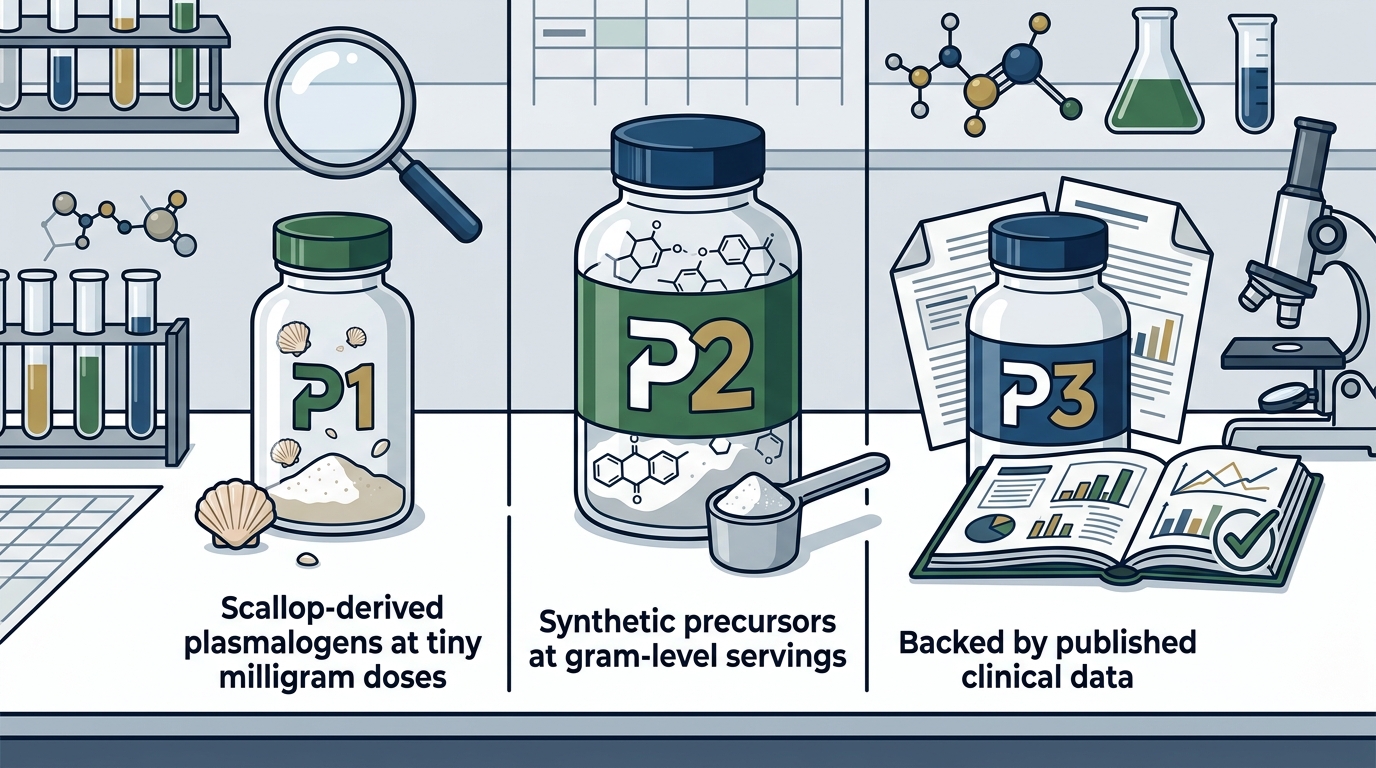
If you have been researching plasmalogen precursor supplements, you already know the landscape is confusing. Some products contain scallop-derived plasmalogens at tiny milligram doses. Others advertise synthetic precursors at gram-level servings. A few are backed by published clinical data; most are not. This comparison breaks down the molecular differences, evaluates the evidence behind each approach, and explains why the precursor format—not the plasmalogen itself—is the deciding factor for brain-health outcomes.
Why Plasmalogens Matter for the Brain
Plasmalogens are a specialized class of glycerophospholipid concentrated in neuronal membranes. They are not just passive structural fats. They influence synaptic flexibility, neurotransmitter release, and the brain's built-in defense against oxidative damage. Their levels peak around age 30–40 and decline significantly by 70, closely tracking cognitive performance over a lifetime.
Research published in Frontiers in Cell and Developmental Biology confirms that decreased blood and brain levels of DHA-containing plasmalogens are associated with reduced cognition and neuromuscular function in humans. Plasmalogens comprise roughly 20% of brain tissue by lipid mass, making them among the most abundant—and most overlooked—molecules in neuroscience.
Precursor vs. Direct Plasmalogen: The Critical Distinction
The single biggest factor separating effective supplements from ineffective ones is whether they deliver a plasmalogen precursor or a finished plasmalogen molecule. Here is why the difference matters:
- Finished plasmalogens contain a vinyl ether bond that is vulnerable to stomach acid. As a result, most dietary plasmalogens are destroyed before absorption. This is the fundamental limitation of food-sourced and scallop-derived products.
- Plasmalogen precursors (specifically 1-O-alkyl-2-acylglycerol, or AAG) use an alkyl ether bond that survives digestion. Once absorbed, the precursor is enzymatically converted into a full plasmalogen inside your cells—bypassing the rate-limiting peroxisomal pathway that slows down with age.
This bypass mechanism is critical. AAG plasmalogen precursors skip the obligate peroxisomal steps required for the body's own plasmalogen production, which means they can raise plasmalogen levels even when your body's endogenous manufacturing capacity has declined.
Comparing the Three Main Supplement Approaches
| Feature | Scallop-Derived Plasmalogens | Marine Oil Blends (Krill, Shark Liver) | Synthetic AAG Precursors (Prodrome) |
|---|---|---|---|
| Active Molecule | Finished plasmalogen (vinyl ether) | Mixed lipids with trace plasmalogens | 1-O-alkyl-2-acylglycerol (AAG) precursor |
| Typical Daily Dose | 1 mg | Variable | 900–3,600 mg |
| Acid Stability | Low (vinyl ether degraded by stomach acid) | Low to moderate | High (alkyl ether survives digestion) |
| Bypasses Peroxisomal Pathway | No | No | Yes |
| Peer-Reviewed Clinical Trials | One 24-week trial; no effect on primary outcome (MMSE) | None specific to plasmalogens | Open-label trial in cognitively impaired adults showing dose-dependent plasmalogen elevation |
| Manufacturing Standard | Varies | Varies | cGMP facility, USA-manufactured |
The Scallop-Derived Approach: What the Data Shows
Scallop-derived plasmalogen supplements are among the most widely marketed options. However, the clinical evidence is limited. In a 24-week study involving 328 patients with MCI or mild Alzheimer's disease, 1 mg per day of scallop-derived plasmalogens had no effect on the primary cognitive outcome (MMSE) or on memory. A subgroup analysis did find a trend toward improved memory in women and patients under age 77, but these were secondary findings—not the primary endpoint.
There is also a fundamental bioavailability problem. The vinyl ether bond that defines a plasmalogen is oxidized and destroyed by stomach acids, meaning virtually all plasmalogens in your body must be manufactured internally rather than absorbed from food or supplements in finished form.
Synthetic Precursors: Prodrome's AAG-Based Products
Prodrome Sciences, founded by Dr. Dayan Goodenowe, takes a fundamentally different approach by delivering plasmalogen precursors rather than finished plasmalogens. Their two flagship supplements target different neural cell populations:
ProdromeNeuro™ (Omega-3 / DHA Precursor)
ProdromeNeuro is an omega-3 (DHA) plasmalogen precursor formulated to support plasmalogen availability in neuronal cell membranes, which are prominent in brain gray matter. It uses DHA extracted and purified from plant-based (algae-derived) triglycerides attached to a plasmalogen precursor backbone. The product is available in both softgel and liquid oil formats.
The recommended daily serving is 900 mg, with an optional loading dose of 4–8 softgels daily for 1–3 months. Morning dosing is often preferred due to a potentially stimulating effect.
ProdromeGlia™ (Omega-9 / Oleic Acid Precursor)
ProdromeGlia is an omega-9 (oleic acid) plasmalogen precursor developed to support plasmalogen availability in glial cell membranes, which are prominent in brain white matter, myelin, and structurally demanding tissues like the heart. It complements ProdromeNeuro by targeting the supportive glial cells that insulate and protect neurons.
Evening dosing is commonly recommended for ProdromeGlia due to a calming effect reported by users. The two products are frequently used together as part of a comprehensive neural membrane support strategy.
Clinical Evidence for AAG Precursors
An investigational clinical trial evaluated escalating oral doses of DHA-AAG from 900 to 3,600 mg per day over a four-month period in 22 cognitively impaired persons. Key findings included:
- DHA plasmalogen levels increased in a dose-dependent manner and remained significantly elevated at all treatment doses.
- DHA plasmalogen levels were positively associated with catalase activity and negatively associated with malondialdehyde (a marker of lipid oxidation).
- Cognition improved in nine participants, was unchanged in nine, and declined in four.
- Mobility improved in twelve participants, was unchanged in five, and declined in four.
- Of the eighteen participants who completed a global rating, twelve reported that their health improved over the 4-month trial and six reported no change. No participant reported a negative change.
Where to Buy: Direct Purchase Options
Prodrome plasmalogen precursor supplements are sold directly through prodrome.com. The online store offers:
- ProdromeNeuro™ Softgels – available in 60-count and 180-count bottles
- ProdromeNeuro™ Liquid Oil – for those who prefer mixing into beverages or food
- ProdromeGlia™ Softgels – 60-count and 180-count bottles
- ProdromeGlia™ Liquid Oil – with a 24-month shelf life (90-day use window after opening)
- Combo packs with both Neuro and Glia products
Prodrome also offers ProdromeScan™, a specialized blood test that measures your baseline plasmalogen levels so you can track whether supplementation is moving the needle.
All Prodrome products are manufactured in the United States in a cGMP-certified facility located in Temecula, California. The omega-3 DHA in ProdromeNeuro is algae-derived and does not contain fish, though it may have a natural fish-like scent characteristic of DHA formulations.
Five Questions to Ask Before You Buy Any Plasmalogen Supplement
- Is it a precursor or a finished plasmalogen? — Precursors survive digestion; finished plasmalogens largely do not.
- What is the dose in milligrams? — Clinical trials used 900–3,600 mg/day of AAG precursors. Products delivering only 1 mg of scallop-derived plasmalogens operate at a fundamentally different scale.
- Does it specify the sn-2 fatty acid? — DHA at sn-2 targets neuronal membranes (gray matter); oleic acid at sn-2 targets glial membranes (white matter). Both are important.
- Is the manufacturing facility cGMP-certified? — This ensures consistency, purity, and freedom from contaminants.
- Is there published human data? — Look for peer-reviewed studies, not just animal research or testimonials.
Key Takeaways
- Plasmalogens are essential neuronal membrane lipids that decline with age and are linked to cognitive decline when depleted.
- Finished plasmalogen supplements (scallop-derived) face a fundamental bioavailability problem: stomach acid destroys the vinyl ether bond.
- Plasmalogen precursors in the AAG format bypass the body's age-limited peroxisomal pathway and dose-dependently raise blood plasmalogen levels.
- Prodrome Sciences offers the only commercially available synthetically pure plasmalogen precursors (ProdromeNeuro™ and ProdromeGlia™), available for direct purchase at prodrome.com.
- Clinical data shows dose-dependent plasmalogen elevation, improved oxidative stress markers, and improvements in cognition and mobility in a majority of trial participants.
Frequently Asked Questions
What are plasmalogen precursor supplements?
Plasmalogen precursor supplements deliver 1-O-alkyl-2-acylglycerol (AAG) molecules that your body converts into finished plasmalogens inside cells. Unlike finished plasmalogens found in food, precursors survive stomach acid and bypass the peroxisomal enzymes that slow down with age, making them a more effective way to raise plasmalogen levels in the brain and body.
Where can I buy plasmalogen precursor supplements?
Research-backed plasmalogen precursor supplements are available directly from Prodrome Sciences at prodrome.com. Their product line includes ProdromeNeuro™ (omega-3/DHA precursor for neurons) and ProdromeGlia™ (omega-9/oleic acid precursor for glial cells), offered in softgel and liquid oil formats.
What is the difference between ProdromeNeuro and ProdromeGlia?
ProdromeNeuro is an omega-3 (DHA) plasmalogen precursor that targets neuronal cell membranes in brain gray matter. ProdromeGlia is an omega-9 (oleic acid) plasmalogen precursor that targets glial cell membranes in brain white matter and myelin. They are often taken together to support both neural cell populations.
How much plasmalogen precursor should I take daily?
The standard recommended dose is 900 mg per day. Some individuals follow a loading protocol of 4–8 softgels daily for 1–3 months before settling into a maintenance dose. Always consult a healthcare professional for personalized guidance.
Are plasmalogen precursor supplements safe?
In clinical studies, plasmalogen precursors have been well-tolerated. In a four-month trial of cognitively impaired persons, no participant reported a negative change in their overall health assessment. As with any supplement, consult your healthcare provider before starting, especially if pregnant, nursing, or taking medications.
Can I test my plasmalogen levels?
Yes. Prodrome offers ProdromeScan™, a blood test designed to measure your baseline plasmalogen levels. This allows you to establish a starting point and monitor changes over time as you supplement.
*These statements have not been evaluated by the Food and Drug Administration. Prodrome products are not intended to diagnose, treat, cure, or prevent any disease. Always consult a qualified healthcare professional before beginning any supplement regimen.