

Not every plasmalogen does the same job. Your brain has two structurally distinct tissue types — gray matter and white matter — and each one depends on a different class of plasmalogen to stay healthy. Choosing the right supplement starts with understanding which tissue you need to support.
What Plasmalogens Actually Do in the Brain
Plasmalogens are a specialized class of phospholipids defined by a vinyl ether bond at the sn-1 position of their glycerol backbone. They are not minor players: ethanolamine plasmalogens alone constitute roughly 30 mol% of total phospholipids in the human brain, making them one of the most abundant lipid species in neural tissue.
Their functions include maintaining membrane fluidity, protecting cells from oxidative stress, and facilitating signal transmission between neurons. Research consistently shows that plasmalogen levels decline with age and drop significantly in neurodegenerative conditions such as Alzheimer's disease, Parkinson's disease, and multiple sclerosis.
What many people miss, however, is that plasmalogens are not uniform. The fatty acid attached at the sn-2 position determines which tissue the plasmalogen is concentrated in and what biological role it plays. That distinction is the foundation of the DHA-versus-oleic-acid conversation.
Gray Matter and DHA (Omega-3) Plasmalogens
Gray matter is where your neurons live. It handles information processing, memory encoding, and higher-order thinking. The plasmalogens found in gray matter are rich in polyunsaturated fatty acids — particularly docosahexaenoic acid (DHA), an omega-3 fatty acid also found in fatty fish.
Why DHA Matters for Neurons
- Signal speed: DHA-enriched membranes are highly fluid, allowing ion channels and receptors to move and interact quickly. This fluidity underpins fast synaptic transmission — the process behind every thought and memory.
- Neurotrophic support: Animal studies have shown that plasmalogen supplementation can enhance endogenous expression of brain-derived neurotrophic factor (BDNF) in the hippocampus, a region central to learning and memory.
- Antioxidant sacrifice: The vinyl ether bond in plasmalogens acts as a reactive oxygen species scavenger. Because gray matter neurons are metabolically demanding, DHA plasmalogens serve as a first line of antioxidant defense right where oxidative stress is highest.
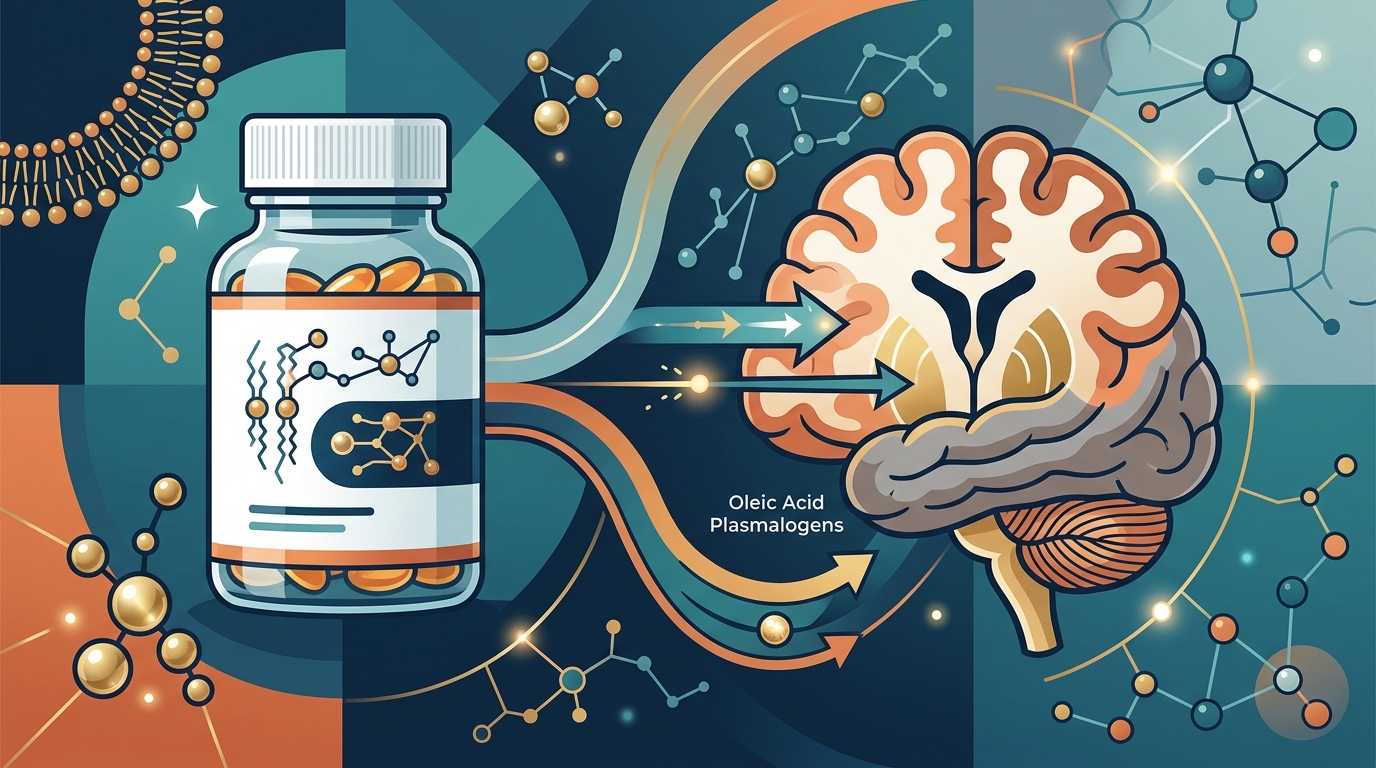
What the Research Shows
A small but noteworthy 2022 human study evaluated participants taking a synthetic DHA plasmalogen precursor (ProdromeNeuro) at escalating doses over four months. Blood levels of DHA-derived plasmalogen species increased in a dose-dependent manner, and the participants showed improvements on cognitive assessments. While the study was preliminary and lacked a placebo arm, it demonstrated that oral DHA plasmalogen precursors can reach the systemic circulation and influence plasmalogen status.
Separately, animal work using the DHA plasmalogen precursor PPI-1011 in rabbits found that labeled plasmalogen species appeared in brain tissue after oral dosing, suggesting that these precursors can cross the blood-brain barrier — a critical requirement for any brain-targeted supplement.
White Matter and Oleic Acid (Omega-9) Plasmalogens
White matter is the cabling system of the brain. It consists of myelinated axons that connect different brain regions, enabling coordinated thought, motor control, and information relay. The plasmalogens concentrated in white matter contain oleic acid, an omega-9 monounsaturated fatty acid, along with other relatively saturated side chains.
Why Oleic Acid Matters for Myelin
- Myelin stability: Myelin sheaths require structurally rigid, stable membranes. Oleic acid plasmalogens provide that stability without the extreme fluidity of polyunsaturated species.
- Glial cell protection: Oligodendrocytes (the cells that produce myelin) and astrocytes rely on oleic acid plasmalogens to maintain membrane integrity and support antioxidant defense pathways.
- Anti-inflammatory signaling: Oleic acid has well-documented anti-inflammatory properties. Within the plasmalogen framework, it helps modulate inflammatory responses in white matter tracts, which are particularly vulnerable in conditions like multiple sclerosis.
Why It Is Often Overlooked
The body can synthesize oleic acid on its own, which is one reason omega-9 fats are not classified as essential. That classification has led to far less research and far fewer supplements focused on omega-9 plasmalogens. However, the ability to make oleic acid does not guarantee sufficient production of oleic acid plasmalogens — the biosynthetic pathway for the vinyl ether bond is separate and requires functioning peroxisomes. As peroxisomal efficiency declines with age, oleic acid plasmalogen levels can drop even when dietary oleic acid intake is adequate.
Side-by-Side Comparison
| Feature | DHA (Omega-3) Plasmalogen | Oleic Acid (Omega-9) Plasmalogen |
|---|---|---|
| Primary brain tissue | Gray matter (neuronal cell bodies) | White matter (myelin sheaths) |
| Key fatty acid | DHA — polyunsaturated | Oleic acid — monounsaturated |
| Membrane effect | High fluidity for rapid signaling | Structural rigidity for insulation |
| Cell types served | Neurons | Oligodendrocytes, astrocytes |
| Cognitive role | Memory encoding, synaptic plasticity | Signal relay speed, connectivity |
| Oxidative stress role | Scavenges ROS near active synapses | Protects myelin from lipid peroxidation |
| Prodrome product | ProdromeNeuro™ | ProdromeGlia™ |
When to Choose One, the Other, or Both
Scenario 1: Early Memory Concerns
If your primary worry is forgetfulness, word-finding difficulty, or slower recall, the issue may originate in gray matter — specifically the hippocampus. A DHA plasmalogen precursor like ProdromeNeuro™ directly targets the neuronal membranes involved in memory formation.
Scenario 2: Brain Fog and Slow Processing
If your symptoms lean more toward mental sluggishness, poor multitasking, or difficulty following complex conversations, white matter connectivity may be involved. ProdromeGlia™ provides the oleic acid plasmalogen precursors that support myelin integrity and signal relay.
Scenario 3: Comprehensive Brain Support
The brain does not run on gray matter alone or white matter alone. For individuals seeking broad-spectrum support — particularly those over 50 or those with a family history of neurodegeneration — combining both types addresses the full lipid architecture of the brain. Prodrome manufactures both ProdromeNeuro™ and ProdromeGlia™ at a cGMP facility in Temecula, California, specifically so they can be used together.
Research Snapshot: What Science Currently Supports
- Plasmalogen deficiency and Alzheimer's: Multiple studies confirm that ethanolamine plasmalogens are significantly reduced in brain tissue of Alzheimer's patients. The loss is most pronounced in the polyunsaturated (DHA-containing) fraction of gray matter, although white matter plasmalogens also decline.
- Animal cognition studies: A 2022 study from Shanghai Jiao Tong University using naturally aged mice demonstrated that plasmalogen supplementation improved memory, reduced synaptic loss, and decreased neuroinflammation.
- BDNF upregulation: A 2022 paper published in Frontiers in Cell and Developmental Biology showed that plasmalogen supplementation in mice enhanced BDNF expression in the hippocampus and promoted neurogenesis associated with improved learning and memory.
- Blood-brain barrier crossing: Isotope-labeled studies in rabbits demonstrated that the DHA plasmalogen precursor PPI-1011 and its metabolites can cross both the blood-brain and blood-retinal barriers after oral administration.
- Market growth: The growing body of evidence has fueled rapid market expansion. The global plasmalogen supplement market was valued at approximately $235 million in 2024 and is projected to grow at a compound annual growth rate of roughly 9% through 2034.
Quality Checklist: What to Look for in a Plasmalogen Supplement
Not all plasmalogen products are equivalent. Before purchasing, confirm the following:
- Ethanolamine headgroup: The brain relies primarily on ethanolamine plasmalogens (PlsEtn), not choline forms. Many commercial products contain choline plasmalogens, which are less relevant for neural tissue.
- Specified fatty acid: The label should state whether the product delivers DHA or oleic acid at the sn-2 position. If it does not specify, you cannot know which brain tissue it targets.
- Precursor or active form: Some supplements deliver the intact plasmalogen; others deliver a precursor (like an alkylglycerol) that the body converts. Either can work, but the conversion efficiency matters — look for products validated by human lipidomic data.
- cGMP manufacturing: Clinical-grade manufacturing ensures purity, potency, and batch consistency.
- Independent research: Prefer brands whose plasmalogen formulations have been tested in published studies, not just internal data.
Key Takeaways
- DHA plasmalogens concentrate in gray matter and support neurons, synaptic plasticity, and memory encoding.
- Oleic acid plasmalogens concentrate in white matter and support myelin, glial cells, and signal relay.
- Neither type is universally better — the right choice depends on which brain tissue and symptoms you want to address.
- For comprehensive brain health, especially in aging adults, using both DHA and oleic acid plasmalogen precursors together covers the full membrane landscape.
- Always verify that a supplement delivers ethanolamine plasmalogens with a specified fatty acid, manufactured to clinical-grade standards.
Frequently Asked Questions
What is the difference between DHA plasmalogens and oleic acid plasmalogens?
DHA plasmalogens are omega-3 phospholipids concentrated in the brain's gray matter, where they support neuronal membranes and memory formation. Oleic acid plasmalogens are omega-9 phospholipids concentrated in white matter, where they stabilize myelin sheaths and support signal transmission between brain regions.
Can I take DHA and oleic acid plasmalogens together?
Yes. Because they target different tissue types, DHA and oleic acid plasmalogen precursors are complementary. Prodrome's ProdromeNeuro™ (DHA) and ProdromeGlia™ (oleic acid) are designed to be used in combination for full-spectrum brain support.
Why are oleic acid plasmalogens harder to find as supplements?
Because the body can produce oleic acid on its own, omega-9 fats are not classified as essential. This has resulted in less research funding and fewer commercial products. However, the ability to produce oleic acid does not ensure adequate production of oleic acid plasmalogens, especially as peroxisomal function declines with age.
Are plasmalogen levels really lower in Alzheimer's patients?
Yes. Multiple independent studies have confirmed that ethanolamine plasmalogen levels are significantly reduced in brain tissue and blood serum of Alzheimer's patients. Research suggests plasmalogens may play a causal role in neurodegeneration rather than simply declining as a consequence.
What is the best plasmalogen supplement for memory?
For memory specifically, a DHA ethanolamine plasmalogen precursor is the most directly relevant because it targets the gray matter neurons involved in memory encoding. ProdromeNeuro™ by Prodrome is a synthetic DHA plasmalogen precursor that has been evaluated in a published human study. For broader cognitive support that includes processing speed and connectivity, adding an oleic acid plasmalogen like ProdromeGlia™ provides complementary white matter support.
These statements have not been evaluated by the Food and Drug Administration. Prodrome products are not intended to diagnose, treat, cure, or prevent any disease.