

Most people shopping for a plasmalogen supplement see two options on the shelf—one built around DHA (omega-3) and another built around oleic acid (omega-9). The labels can look confusingly similar. The difference, however, comes down to which cells inside your brain each type is designed to feed. This cell-type guide walks you through the biology, the evidence, and the practical questions that help you pick the right product—or decide whether you need both.
Why the Cell Type Matters More Than the Fatty Acid Name
Your brain is not a uniform mass of identical cells. It contains billions of neurons that fire electrical signals and an even larger population of glial cells—oligodendrocytes, astrocytes, Schwann cells—that insulate, nourish, and protect those neurons. Each cell population relies on a distinct lipid profile within its membranes. Plasmalogens are a specific type of glycerophospholipid found in especially high levels in neuronal membranes, but they are equally vital in the myelin sheaths produced by glial cells.
Because the sn-2 fatty acid on the plasmalogen backbone determines which membrane environment the molecule best serves, choosing a supplement is really about choosing which cell type you want to support first.
DHA Plasmalogens and the Neuron
Where They Concentrate
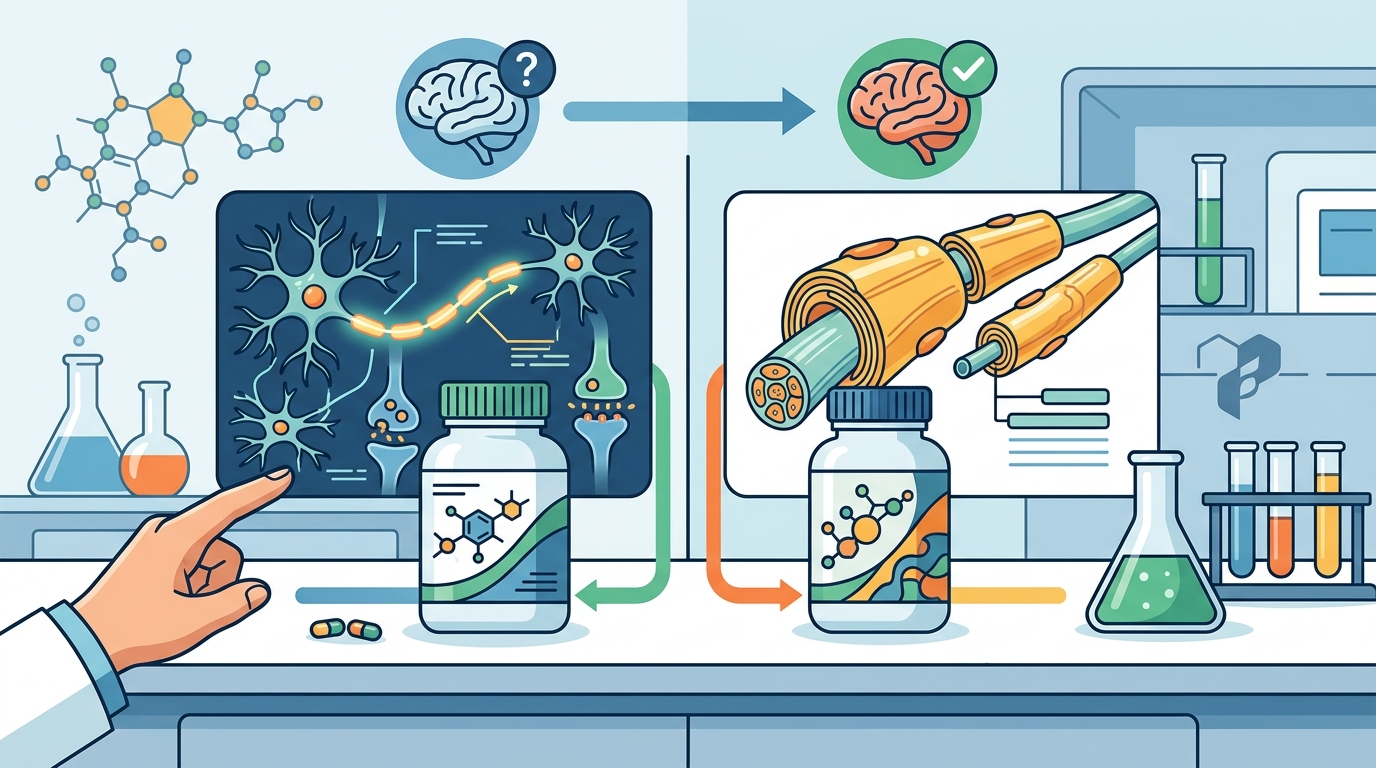
DHA-containing plasmalogens are found in high concentrations in the membranes of gray matter and are necessary for neuron and neuromuscular synaptic function. Gray matter houses the cell bodies of neurons, the synapses where memories are encoded, and the hippocampus—the brain region most closely linked to learning and recall.
What They Do
- Synaptic signaling: DHA plasmalogens help maintain the fluidity and curvature of synaptic membranes, which is essential for vesicle fusion and neurotransmitter release.
- Amyloid regulation: They are involved in reverse cholesterol transport and maintaining low brain amyloid levels, a key concern for anyone worried about Alzheimer's risk.
- Antioxidant shielding: The vinyl-ether bond at sn-1 can sacrifice itself to neutralize reactive oxygen species, protecting the polyunsaturated DHA at sn-2 from oxidative damage.
- BDNF expression: Animal research has shown that oral DHA-enriched plasmalogen supplementation improved learning and memory in part through enhanced brain-derived neurotrophic factor (BDNF) expression.
What Happens When DHA Plasmalogen Levels Drop
Decreased blood and brain levels of DHA-containing plasmalogens are associated with decreased cognition and neuromuscular function in humans. People with dementia experience a rapid decline in plasmalogens, particularly omega-3 plasmalogens, which is why DHA plasmalogen restoration is of special interest for cognitive decline.
Oleic Acid Plasmalogens and the Glial Cell
Where They Concentrate
Oleic acid (omega-9) plasmalogens are especially important for cells involved in supporting and stabilizing neural signaling environments, including glial cells that surround and support neurons. These cells are densest in white matter—the brain tissue that connects different cortical regions through myelinated axon bundles.
The Myelin Connection
In myelin-rich white matter, plasmalogens make up more than 30 percent of total phospholipids—a much higher proportion than the roughly 20 percent seen in gray matter. Myelin is also particularly enriched in plasmalogens containing saturated and monounsaturated fatty acids, which is why oleic acid (a monounsaturated omega-9) is the dominant sn-2 species in myelin plasmalogens rather than DHA.
White matter is largely made up of myelin, which requires high levels of omega-9 plasmalogens to function. Healthy myelin means faster signal conduction, better coordination between brain regions, and preserved executive function as you age.
What They Do
- Myelin maintenance: Omega-9 plasmalogen precursors have been shown to prevent demyelination and neurodegeneration and reduce lipid peroxidation.
- Structural resilience: Oleic-acid-containing plasmalogens are key components of glial membranes and are involved in maintaining structural integrity and cellular resilience during periods of increased stress.
- Heart and peripheral nerve support: The omega-9 plasmalogen precursor nourishes oligodendrocytes and Schwann cells, but also myocytes in the heart and smooth muscle cells—an important secondary benefit.
Research Snapshot: What Studies Show So Far
| Study Focus | Type | Key Finding |
|---|---|---|
| DHA-AAG dose escalation in 22 cognitively impaired adults (Frontiers in Cell and Developmental Biology, 2022) | Open-label clinical trial | DHA plasmalogen levels increased with increasing dose and remained significantly elevated at all treatment doses. Cognition improved in nine participants, was unchanged in nine, and declined in four. |
| DHA-enriched plasmalogens in mice (Hossain et al., 2022) | Animal model | Oral DHA-enriched plasmalogen supplementation increased hippocampal plasmalogen levels, improved learning and memory, and modulated cell signaling pathways. |
| Plasmalogen precursor PPI-1011 in rabbits (Wood et al., 2011) | Pharmacokinetics | Repeated oral dosing resulted in dose-dependent increases in circulating DHA and DHA-containing plasmalogens, with evidence of blood-brain barrier crossing. |
| Omega-9 plasmalogen precursors (Prodrome preclinical data) | Preclinical | Precursors have been shown to prevent demyelination, reduce neurodegeneration, and lower lipid peroxidation markers. |
| Ascidian-derived plasmalogens in healthy Japanese adults (12-week RCT) | Randomized controlled trial | 1 mg daily of mixed plasmalogens (containing EPA, DHA, oleic acid, and arachidonic acid) slightly improved composite memory and visual memory versus placebo. |
Note: Research in this area is still emerging. Many findings come from animal models or small clinical trials. Larger, longer human studies are needed to confirm effect sizes.
Scenario Picker: Match Your Goals to a Plasmalogen Type
Rather than a simple “this or that” answer, use the following real-world scenarios to guide your decision.
Scenario 1 — You Are Over 50 and Noticing Forgetfulness
Plasmalogen levels naturally decline after the age of 50. Because early memory complaints usually involve synaptic function in gray matter, a DHA plasmalogen precursor (such as ProdromeNeuro™) addresses the most immediate concern. DHA plasmalogens target the synapses where short-term memories are consolidated.
Scenario 2 — You Have a Family History of Multiple Sclerosis or White-Matter Lesions
White-matter degeneration can affect many neurological functions, including movement, sensation, and thinking. An omega-9 plasmalogen precursor (such as ProdromeGlia™) specifically supports myelin integrity and may be the logical starting point if white matter health is your priority.
Scenario 3 — You Are a Caregiver for Someone With Dementia
People with cognitive impairment often show deficits in both gray-matter synaptic function and white-matter connectivity. In clinical settings, ProdromeNeuro and ProdromeGlia are often used together as part of a broader nutritional approach to supporting different cell types within the nervous system.
Scenario 4 — You Want Whole-Body Benefits Beyond the Brain
Oleic acid plasmalogens also support heart myocytes, peripheral Schwann cells, and smooth muscle throughout the body. If you are looking for cardiovascular and nervous-system support in a single supplement, ProdromeGlia offers that broader reach.
Why Many Users Combine Both
The brain is roughly 60 percent white matter and 40 percent gray matter in volume, yet most of the public conversation about brain health focuses only on neurons. Supporting only one compartment leaves the other undersupplied.
ProdromeNeuro™ and ProdromeGlia™ are designed with complementary focus on neuronal and glial membrane composition. ProdromeNeuro targets gray matter synaptic performance—think memory encoding and recall. ProdromeGlia targets white matter insulation—think processing speed and coordination. Using them together addresses both the “performer” (neurons) and the “protector” (glial cells) sides of brain health.
Both products are manufactured in a cGMP-certified facility in Temecula, CA, and are bioidentical to naturally occurring plasmalogen precursors.
Key Takeaways
- DHA plasmalogens feed neurons in gray matter, support synaptic function, aid amyloid clearance, and are the first priority when cognitive recall is the concern.
- Oleic acid plasmalogens feed glial cells in white matter, maintain myelin insulation, and offer additional heart and peripheral nerve benefits.
- Neither type replaces the other. They serve different cell populations with different lipid needs.
- Combination use is common and supported by the complementary biology of gray and white matter.
- Research is promising but early. Speak with a healthcare provider to tailor supplementation to your individual health profile.
Frequently Asked Questions
Are DHA plasmalogens the same as regular DHA fish oil?
No. Standard fish oil delivers DHA as a triglyceride or ethyl ester. A DHA plasmalogen precursor delivers DHA already attached to a vinyl-ether backbone, which is the form your cell membranes actually use. The structural difference matters because the plasmalogen form supports membrane-specific functions like vesicle fusion and antioxidant protection that free DHA does not replicate on its own.
Can I get enough plasmalogens from food alone?
Animal-based foods such as organ meats, scallops, and mussels contain plasmalogens, and some provide meaningful amounts per serving. However, achieving the concentrated, targeted doses used in clinical research through diet alone is impractical for most people, which is why supplements like ProdromeNeuro and ProdromeGlia exist.
How long before I might notice a difference?
Clinical studies have used supplementation periods ranging from 12 weeks to 6 months. Individual responses vary, but most research protocols evaluate outcomes at the 3-month mark.
Is it safe to take both ProdromeNeuro and ProdromeGlia at the same time?
Yes. The two products target different cell types and are commonly used together. Clinical trials with plasmalogen supplements have shown no serious adverse effects at recommended doses, though mild gastrointestinal discomfort has been reported occasionally.
Who should avoid plasmalogen supplements?
Pregnant or breastfeeding women, children, and individuals with severe liver conditions should consult a physician first, as long-term safety data in these groups is limited. If you have a shellfish allergy, check the source—Prodrome products are synthesized from plant-based precursors, not marine animals.