

Plasmalogen levels in the blood decline significantly with age, creating a biological deficit that impacts cellular integrity across the entire body. Research indicates that individuals with higher baseline plasmalogen levels are 80% less likely to experience dementia, highlighting the critical nature of maintaining these specialized lipids. This statistic underscores why targeted supplementation has become a focal point in longevity and cognitive health strategies. Understanding the distinct roles of white matter versus grey matter support is essential for selecting the correct intervention.
White Matter Support: The Role of ProdromeGlia
ProdromeGlia is engineered specifically to address the structural needs of the brain's white matter. White matter consists of nerve fibers covered by myelin, which acts as the insulation for your nervous system. Plasmalogens are fundamental building blocks for this myelin sheath. Without adequate plasmalogen availability, the structural integrity of these nerve fibers can compromise, leading to slower signal transmission.
The primary focus of ProdromeGlia is to solidify and amplify the signals between neurons by reinforcing the physical structure of the brain's wiring. This product is designed for individuals who need to support the physical infrastructure of their neural networks. It targets the stability of the cell membranes that surround nerve fibers, ensuring that electrical impulses travel efficiently without degradation.
Myelin is not just passive insulation; it is a dynamic structure that requires constant maintenance. As we age, the body's ability to produce new myelin decreases. ProdromeGlia provides the specific lipid precursors needed to support this maintenance process. This makes it a critical component for those concerned with long-term neurological health and the preservation of cognitive processing speed.
Grey Matter Signaling: The Function of PlasmalogenN3
PlasmalogenN3, formerly known as a different formulation, is designed to target the grey matter of the brain. Grey matter contains the majority of the brain's neuronal cell bodies and is responsible for processing information, muscle control, and sensory perception. Unlike the structural focus of white matter, grey matter relies heavily on functional signaling.
This product supports neurotransmitter release and receptor activity. Plasmalogens in the grey matter help regulate how brain cells communicate with each other. They play a key role in the fluidity of the cell membrane, which allows receptors to open and close properly in response to chemical signals. This functional support is vital for memory formation, learning, and overall cognitive flexibility.
The distinction here is subtle but profound. While ProdromeGlia builds the road, PlasmalogenN3 optimizes the traffic flow on that road. It ensures that the communication between neurons is robust and responsive. This makes PlasmalogenN3 particularly relevant for individuals seeking to enhance cognitive performance, mental clarity, and the efficiency of neural processing.
Structural Integrity vs Functional Signaling
Understanding the difference between structural support and functional signaling is the key to choosing between these two protocols. The brain is not a monolithic organ; it is divided into distinct regions with different biological requirements. White matter and grey matter operate on different principles, and therefore, they require different lipid profiles for optimal health.
ProdromeGlia focuses on the "hardware" of the brain. It strengthens the myelin sheath, which protects nerve fibers and ensures that signals are not lost or delayed. This is analogous to repairing the insulation on electrical wires to prevent short circuits and signal loss. It is a foundational approach to brain health that prioritizes longevity and structural resilience.
PlasmalogenN3 focuses on the "software" of the brain. It enhances the communication protocols between neurons. By supporting receptor function and neurotransmitter dynamics, it helps the brain process information more effectively. This is analogous to upgrading the operating system to run applications faster and more efficiently. It is a performance-oriented approach that prioritizes cognitive output and mental agility.
Clinical Applications and Target Demographics
Health professionals often prescribe these products based on specific patient presentations and clinical goals. For patients exhibiting signs of demyelination or those at high risk for neurodegenerative conditions, ProdromeGlia may be the preferred starting point. The goal is to stabilize the neural infrastructure before functional decline becomes apparent.
Conversely, for individuals seeking cognitive enhancement or those experiencing early signs of memory lapses, PlasmalogenN3 may be more appropriate. It addresses the immediate functional deficits in communication between brain cells. Some practitioners may recommend a combination of both to address the entire spectrum of brain health, from structure to function.
The choice also depends on the individual's age and health history. Younger individuals focused on performance might lean toward PlasmalogenN3. Older adults focused on preservation and protection might lean toward ProdromeGlia. However, the most effective protocols are often personalized based on blood test results and specific biomarker analysis.
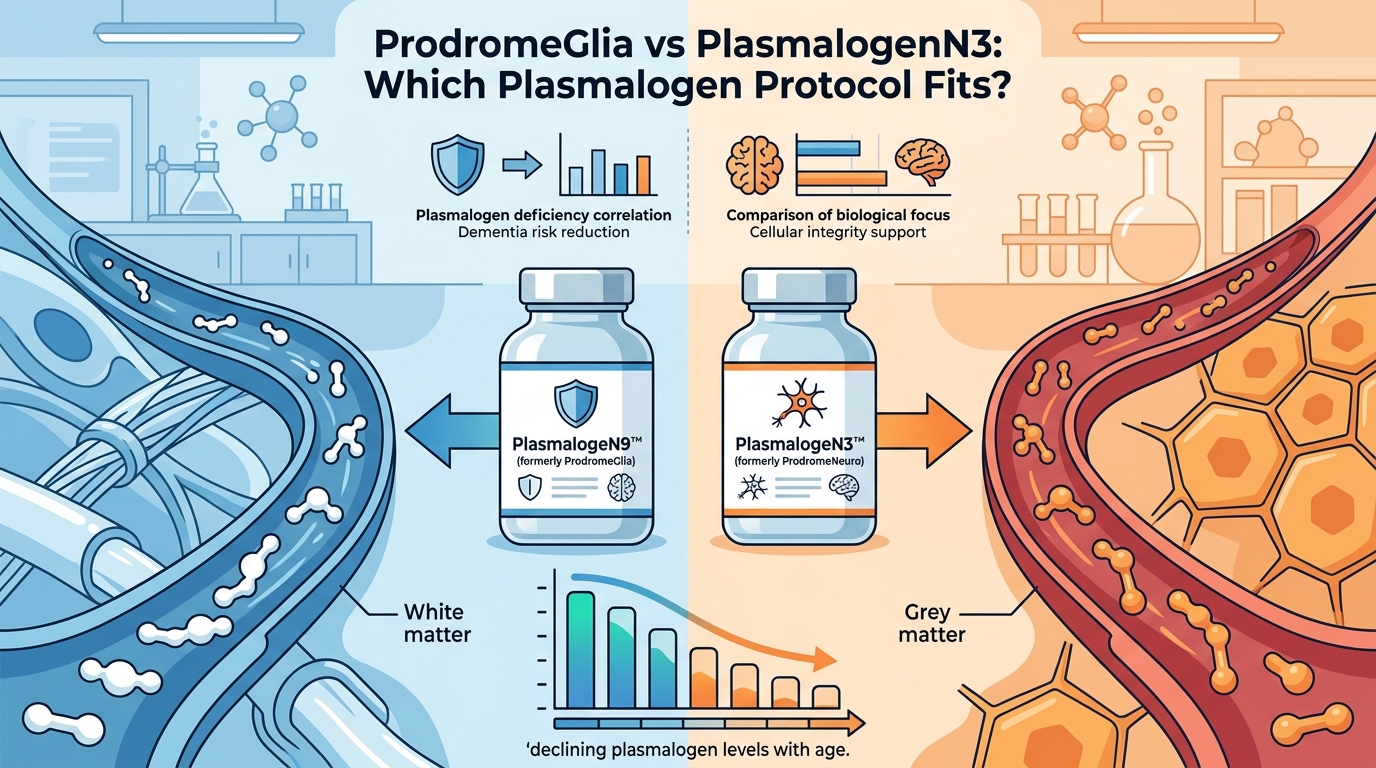
Product Comparison Matrix
| Feature | ProdromeGlia | PlasmalogenN3 |
|---|---|---|
| Primary Target | White Matter | Grey Matter |
| Core Function | Myelin Sheath Support | Neurotransmitter Signaling |
| Biological Focus | Structural Integrity | Functional Communication |
| Key Benefit | Nerve Fiber Protection | Cognitive Processing Speed |
| Best For | Long-term Preservation | Performance & Clarity |
Key Takeaways
- Plasmalogens are specialized lipids that are critical for cell membrane integrity and function.
- ProdromeGlia targets white matter to support myelin sheath structure and nerve signal insulation.
- PlasmalogenN3 targets grey matter to enhance neurotransmitter release and receptor activity.
- Structural support (Glia) and functional signaling (N3) are complementary aspects of brain health.
- Higher blood plasmalogen levels are associated with an 80% reduction in dementia risk.
- Prodrome Science utilizes over 30 years of lipid research to formulate these targeted protocols.
- Consulting with a health professional is recommended to determine the appropriate protocol based on individual biomarkers.
Frequently Asked Questions
Can I take ProdromeGlia and PlasmalogenN3 together?
Yes, many health professionals recommend combining both products to address both the structural and functional aspects of brain health simultaneously. This comprehensive approach ensures that the brain's wiring is protected while its communication systems are optimized.
What is the difference between white matter and grey matter?
White matter consists of nerve fibers covered by myelin, which facilitates the transmission of signals. Grey matter contains neuronal cell bodies and is responsible for processing information and controlling muscle function. Both are essential for cognitive health.
How do plasmalogens support myelin sheath integrity?
Plasmalogens are a key component of the myelin sheath. They provide the necessary lipid structure to maintain the stability and insulation of nerve fibers, ensuring that electrical impulses travel efficiently without degradation.
Is PlasmalogenN3 the same as the old formulation?
PlasmalogenN3 is the updated name for a previous formulation. It is specifically designed to target grey matter and support functional signaling through enhanced neurotransmitter dynamics.
Why are plasmalogens important for aging?
Plasmalogen levels naturally decline with age. This decline impacts cellular integrity, mitochondrial function, and oxidative defense. Supplementing with plasmalogens helps counteract this decline and supports healthy aging at the cellular level.
How does Prodrome ensure product purity?
Prodrome uses advanced biomarker technologies and rigorous testing protocols to ensure the authenticity and potency of their plasmalogen supplements. They prioritize lipid science to deliver high-quality, bioavailable products.
Can plasmalogens improve cognitive performance?
By supporting grey matter function and neurotransmitter release, plasmalogens can enhance cognitive performance, including memory, focus, and mental clarity. They help maintain the efficiency of neural communication.
Conclusion
Choosing between ProdromeGlia and PlasmalogenN3 depends on your specific health goals and biological needs. If your priority is structural protection and long-term neurological preservation, ProdromeGlia is the ideal choice. If your focus is on enhancing cognitive performance and neural communication, PlasmalogenN3 offers targeted support.For optimal results, consider consulting with a health professional to determine the best protocol for your individual situation. You can explore the full range of plasmalogen products and science-backed protocols by visiting the Prodrome Science collection. To learn more about the lipid science behind these products, visit the Prodrome Science Blog.