

DHA vs. Oleic Acid Plasmalogens for Memory Support: Which Is Better?
If you are exploring plasmalogen supplements for memory and brain health, you have likely encountered two distinct types: DHA (omega-3) plasmalogens and oleic acid (omega-9) plasmalogens. Both play essential roles in the brain, yet they target different cell populations and serve different biological functions. Understanding the distinction is not just academic; it can shape which supplement delivers the results you are looking for. This guide breaks down the science, compares the two head to head, and helps you decide which plasmalogen type fits your needs.
What Are Plasmalogens?
Plasmalogens are a subclass of glycerophospholipids characterized by a vinyl ether-linked fatty alcohol at the sn-1 position of the glycerol backbone. They constitute roughly 18 to 20 percent of total phospholipids in human cell membranes and are especially abundant in the brain, heart, and retina. Their levels naturally decline with age, and this decline is strongly associated with Alzheimer's disease and dementia.
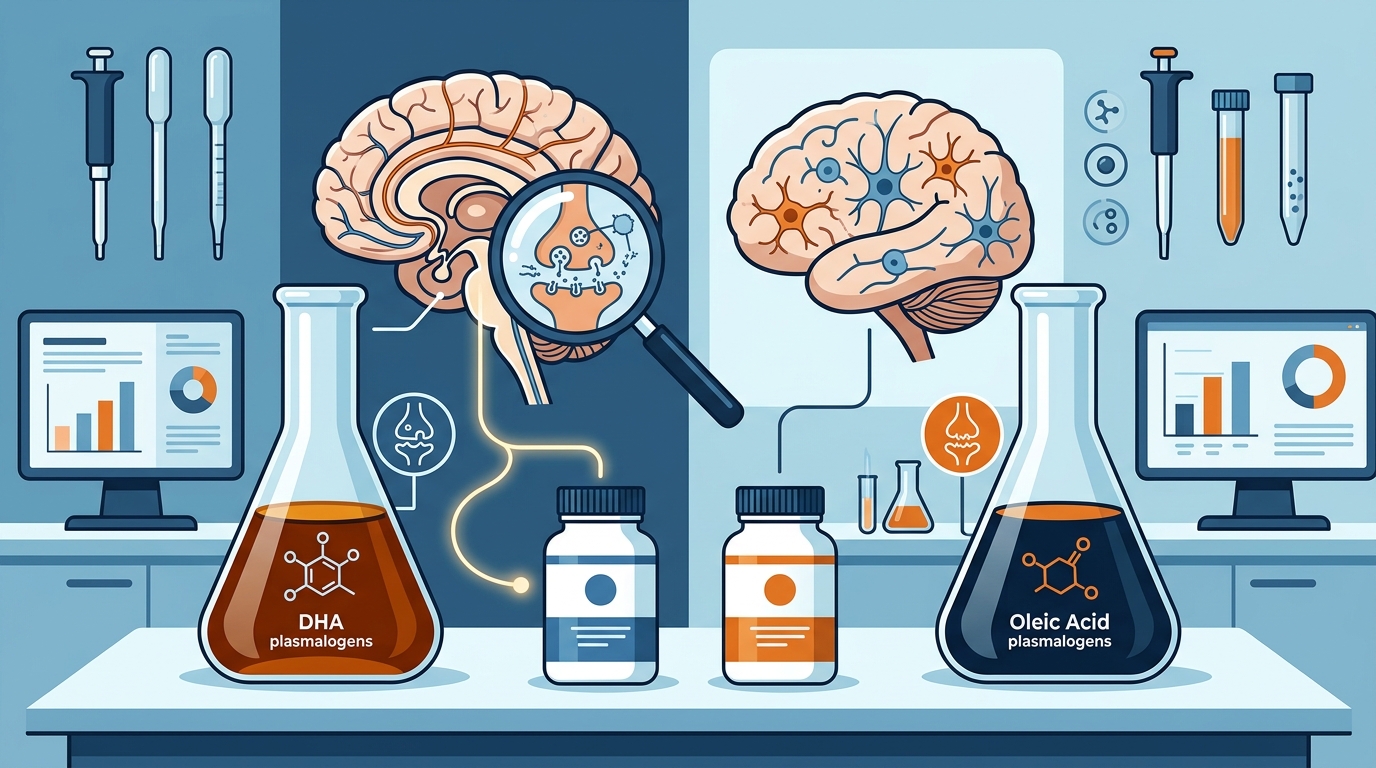
The fatty acid attached at the sn-2 position determines a plasmalogen's functional identity. When that fatty acid is DHA, the plasmalogen supports neuronal signaling in gray matter. When it is oleic acid, the plasmalogen supports myelin and white matter architecture.
How DHA Plasmalogens Support Memory
DHA plasmalogens are the dominant plasmalogen species in brain gray matter, where neurons process and transmit information. A DHA plasmalogen is a glycerophospholipid carrying docosahexaenoic acid (22:6, omega-3) at the sn-2 position, enabling high membrane fluidity and rapid signal transduction.
Neuronal Signaling and Cognition
Research published in Frontiers in Molecular Biosciences demonstrated that DHA-containing plasmalogen precursors dose-dependently increase blood DHA plasmalogens and show neuroprotective effects in animal models of neurodegeneration. In a clinical trial of 22 cognitively impaired persons, an escalating DHA-AAG dosing regimen from 900 to 3,600 mg per day over four months improved cognition and mobility outcomes.
Amyloid Reduction
In vitro studies show that increasing membrane levels of DHA plasmalogens upregulates the alpha-secretase pathway, shifting amyloid precursor protein processing away from the harmful beta-amyloid pathway. This mechanism positions DHA plasmalogens as a key tool for supporting healthy amyloid metabolism.
ProdromeNeuro is an omega-3 (DHA) plasmalogen precursor designed to restore and optimize cellular functions in brain gray matter, neuron and neuromuscular synaptic function, and reverse cholesterol transport.
How Oleic Acid Plasmalogens Protect the Brain
An oleic acid plasmalogen is a glycerophospholipid carrying oleic acid (18:1, omega-9) at the sn-2 position, providing structural stability to glial cell membranes, myelin sheaths, and white matter tissue. While DHA plasmalogens drive signaling speed, oleic acid plasmalogens maintain the insulation and structural framework that keeps those signals organized.
White Matter and Myelin Support
White matter is largely made up of myelin, which requires high levels of omega-9 plasmalogens to function properly. Oleic acid plasmalogens are especially important for oligodendrocytes and Schwann cells, the glial cells that build and maintain the protective coatings around neurons.
Calming and Structural Resilience
Many users report that ProdromeGlia, Prodrome's omega-9 plasmalogen precursor, provides a calming effect. This aligns with its role in stabilizing neural signaling environments and supporting membrane integrity under stress. The oleic acid in ProdromeGlia is extracted and purified from organic high-oleic-acid sunflower meal.
Side-by-Side Comparison: DHA vs. Oleic Acid Plasmalogens
| Feature | DHA Plasmalogen (Omega-3) | Oleic Acid Plasmalogen (Omega-9) |
|---|---|---|
| Primary brain target | Gray matter, neurons | White matter, glial cells, myelin |
| Key fatty acid | DHA (22:6) | Oleic acid (18:1) |
| Primary function | Signal transduction, membrane fluidity | Structural insulation, membrane stability |
| Cognitive role | Memory recall, synaptic activity | Focus, calm, nerve signal organization |
| Amyloid pathway effect | Upregulates alpha-secretase | Indirect structural support |
| Prodrome product | ProdromeNeuro | ProdromeGlia |
| Suggested timing | Morning (stimulating) | Evening (calming) |
| Concentration per serving | 900 mg | 900 mg |
Who Needs Which Plasmalogen?
Choosing between DHA and oleic acid plasmalogens depends on your health goals, age, and current cognitive status. People experiencing memory decline, particularly those with dementia, tend to show the most rapid loss of omega-3 plasmalogens, making DHA supplementation a priority.
Consider DHA Plasmalogens If You Want To:
- Support active memory recall and synaptic function
- Address age-related cognitive decline
- Promote healthy amyloid metabolism
Consider Oleic Acid Plasmalogens If You Want To:
- Support myelin integrity and nerve insulation
- Promote calm focus and stress resilience
- Maintain white matter health long-term
The best way to know your specific plasmalogen levels is through the ProdromeScan blood test, developed by Dr. Dayan Goodenowe, which measures individual plasmalogen profiles and guides supplementation choices.
Why Many People Use Both Together
ProdromeNeuro and ProdromeGlia are often used together as part of a broader nutritional approach to supporting different cell types within the nervous system. ProdromeNeuro targets neuronal membranes while ProdromeGlia targets glial membranes. A common regimen involves taking ProdromeNeuro in the morning for cognitive performance and ProdromeGlia in the evening for structural rebuilding during sleep.
Both products deliver 900 mg of plasmalogen precursors per serving, far exceeding other products on the market that may contain as little as 0.5 mg per capsule. Prodrome's plasmalogen precursors are manufactured in a cGMP-certified facility in Temecula, California, and are designed to bypass gut degradation for optimal absorption.
Key Takeaways
- DHA plasmalogens target gray matter neurons and support memory recall, synaptic function, and amyloid metabolism.
- Oleic acid plasmalogens target white matter glial cells, myelin sheaths, and structural brain stability.
- Plasmalogen levels decline with age and are significantly lower in people with Alzheimer's disease and dementia.
- ProdromeNeuro (DHA) and ProdromeGlia (oleic acid) are the only patented plasmalogen precursors validated in human lipidomic studies.
- Many people benefit from taking both types together for comprehensive neuronal and glial support.
- The ProdromeScan blood test can help identify your specific plasmalogen deficiencies.
- Prodrome products deliver 900 mg per serving, compared to as little as 0.5 mg per capsule from competitors.
Frequently Asked Questions
What is the main difference between DHA and oleic acid plasmalogens?
DHA plasmalogens carry docosahexaenoic acid and primarily support neuronal signaling in brain gray matter. Oleic acid plasmalogens carry oleic acid and primarily support structural integrity of glial cells and myelin in brain white matter. They serve complementary roles in overall brain health.
Can I take both ProdromeNeuro and ProdromeGlia at the same time?
Yes. Many users take ProdromeNeuro in the morning for cognitive performance and ProdromeGlia in the evening for calming structural support. The two products target different cell types and work together to support the full nervous system.
How do plasmalogen precursors differ from regular fish oil?
Fish oil provides free DHA and EPA but contains zero plasmalogens. Prodrome's plasmalogen precursors use a patented alkyl-acylglycerol backbone that bypasses gut degradation and is efficiently converted into the exact plasmalogen species your brain cells use.
Are Prodrome plasmalogen supplements vegetarian?
ProdromeNeuro uses DHA extracted from algae oil, and ProdromeGlia uses oleic acid extracted from organic sunflower meal. Both core products are vegetarian friendly.
How do I know which plasmalogen I am deficient in?
The ProdromeScan blood test, developed by Dr. Dayan Goodenowe, measures your individual plasmalogen, phospholipid, and fatty acid levels. This test provides personalized data to guide your supplementation strategy.
How long does it take to see results from plasmalogen supplementation?
In the published clinical trial using DHA-AAG, participants followed an escalating dose protocol over four months. Individual responses vary based on baseline deficiency levels, age, and overall health status. Consistency is key.
Why are Prodrome products more concentrated than other plasmalogen supplements?
Most commercial plasmalogen products are derived from animal sources such as scallops or sea squirts and contain very low concentrations. Prodrome products deliver 900 mg of plasmalogen precursors per serving and 27,000 mg per bottle because they use a patented synthetic process engineered for purity and bioavailability.
Do plasmalogens help with Alzheimer's disease?
Research shows that decreased levels of ethanolamine plasmalogens are commonly found in Alzheimer's patients and correlate with cognitive decline. Supplementation with plasmalogen precursors has shown positive outcomes in clinical and animal studies, though these products are not intended to diagnose, treat, cure, or prevent any disease.
Find Out Which Plasmalogen Is Right for You
Your brain uses both DHA and oleic acid plasmalogens every day. The question is whether your body can still make enough of them. Explore the science behind omega plasmalogens or start with a ProdromeScan blood test to discover your personal plasmalogen profile and take the next step toward targeted brain health support.