

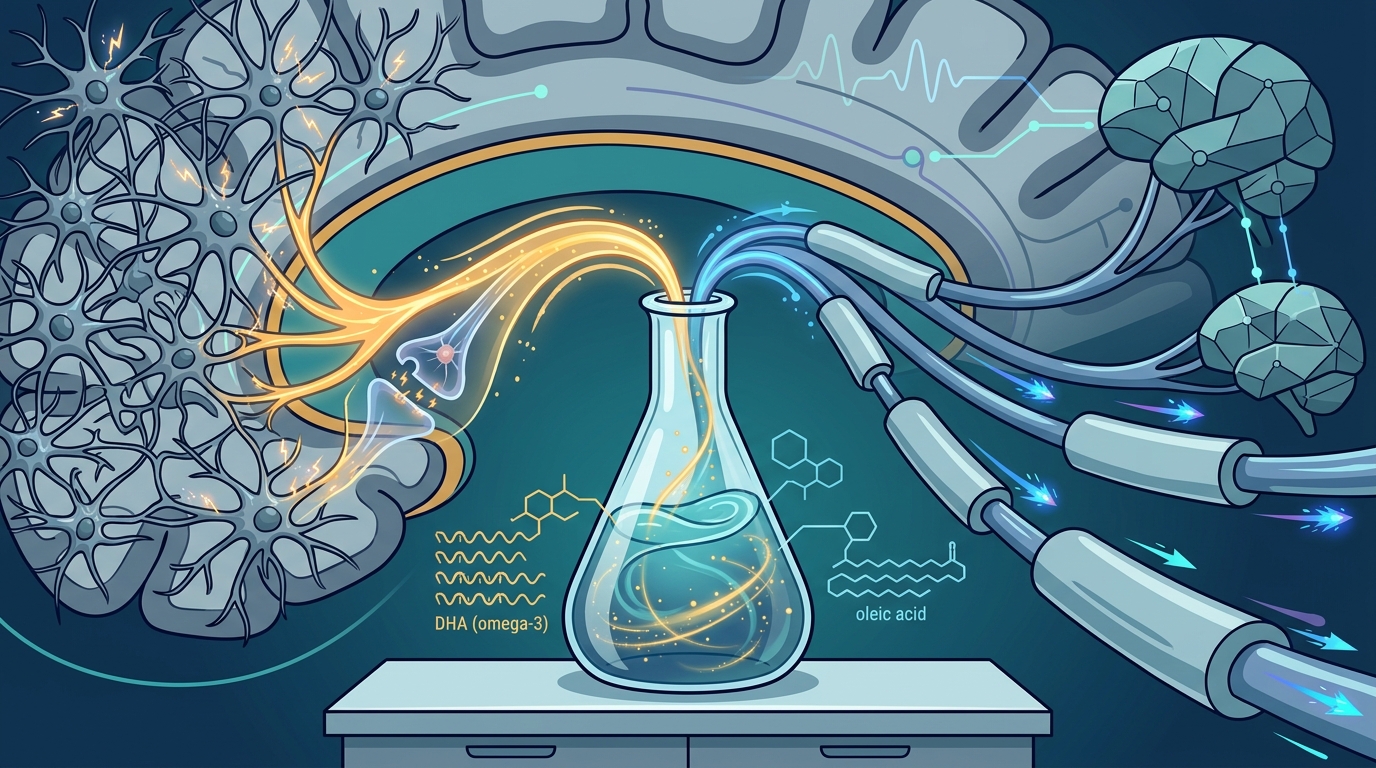
Memory is not a single event. It begins when a neuron fires in the hippocampus, but the signal only becomes useful when it travels—at speed—through myelinated axons to distant brain regions for storage, retrieval, and integration. Two classes of plasmalogen support those two stages. DHA (omega-3) plasmalogens concentrate in the neuronal membranes of gray matter, where memories are encoded. Oleic acid (omega-9) plasmalogens concentrate in glial cells and myelin sheaths of white matter, where signals are relayed. Asking which is “better” for memory is like asking whether a computer’s processor or its data bus matters more. The honest answer: both are essential, but they solve different problems.
This comparison walks through the biochemistry, the clinical evidence, and a practical framework for deciding which type—or combination—fits your goals.
What Plasmalogens Actually Are (60-Second Primer)
Plasmalogens are a subclass of glycerophospholipid distinguished by a vinyl-ether bond at the sn-1 position of the glycerol backbone. That bond makes them structurally unique: it increases liquid order in the membrane and gives them inherent antioxidant properties because the vinyl-ether linkage can scavenge reactive oxygen species.
The fatty acid at the sn-2 position determines a plasmalogen’s tissue affinity. DHA (22:6, omega-3) and arachidonic acid (20:4, omega-6) dominate in brain gray matter, while oleic acid (18:1, omega-9) and other longer monounsaturated chains are enriched in myelin and white matter. This is not an arbitrary preference—each fatty acid changes how the membrane bends, how fast it transmits signals, and which enzymes interact with it.
DHA Plasmalogens: The Gray-Matter Performers
Where They Live
DHA-containing ethanolamine plasmalogens (PlsEtn-DHA) are found at especially high concentrations in the membranes of neurons, particularly in the hippocampus and frontal cortex—brain regions most associated with memory formation and executive function.
How They Support Memory
- Synaptic plasticity: DHA plasmalogens modulate SNARE proteins that mediate synaptic vesicle exocytosis and membrane fusion, directly influencing how efficiently neurons communicate at the synapse.
- BDNF upregulation: Animal research has shown that oral DHA-enriched plasmalogen supplementation increases hippocampal plasmalogen levels, improves learning and memory, and enhances brain-derived neurotrophic factor (BDNF) expression through ERK-Akt signaling pathways.
- Anti-neuroinflammation: DHA-containing plasmalogens were more effective than non-DHA sources at inhibiting microglial activation, a well-known driver of memory impairment in Alzheimer’s disease.
- Amyloid regulation: In plasmalogen-rich membrane domains, amyloid precursor protein (APP) is preferentially processed by alpha-secretase rather than gamma-secretase, reducing the formation of toxic amyloid-beta aggregates.
What the Human Data Show
A clinical trial of 22 cognitively impaired persons evaluated an escalating oral dosing regimen of DHA-AAG (a plasmalogen precursor containing DHA at the sn-2 position) from 900 to 3,600 mg per day over four months. The precursor was well tolerated at all dosages with no adverse reactions observed. Post-mortem brain analysis of 100 elderly individuals found that participants with high levels of DHA-plasmalogens were far more likely to have remained cognitively normal, while those with low levels and high pathology showed dementia—even after controlling for amyloid plaque burden.
Key Takeaway
DHA plasmalogens address the encoding side of memory: synaptic firing, neurogenesis, and inflammatory control in the regions where memories are born.
Oleic Acid Plasmalogens: The White-Matter Protectors
Where They Live
Oleic acid plasmalogens are the dominant plasmalogen species in myelin sheaths—the lipid-rich insulation produced by oligodendrocytes (in the central nervous system) and Schwann cells (in the peripheral nervous system). In myelin-rich white matter, plasmalogens make up more than 30% of total phospholipids, and more than 80% of phosphatidylethanolamine (PE) lipids in myelin are plasmalogens.
How They Support Memory
- Signal conduction speed: Myelin insulates axons so electrical signals can jump quickly between nodes of Ranvier. When myelin degrades, signal speed drops—impacting processing speed, working memory, and recall latency.
- Structural stability: Oleic acid’s monounsaturated chain provides a balance of membrane rigidity and flexibility that is ideal for insulation. This is why myelin plasmalogens tend to carry more saturated or monounsaturated side chains compared to gray matter plasmalogens.
- Glial cell health: Oligodendrocytes must continuously maintain and repair myelin throughout adulthood. Oleic acid plasmalogen precursors supply the raw material these cells need to sustain the insulation layer.
- Antioxidant defense in white matter: The vinyl-ether bond acts as a sacrificial antioxidant, protecting the lipid-dense myelin environment from oxidative damage that accelerates with age.
Why This Matters for Memory Specifically
Memory retrieval depends on speed and coordination across distributed brain networks. When white matter integrity declines—something visible on MRI as white matter hyperintensities—people experience slower processing speed, reduced working memory, and more “tip of the tongue” moments. Supporting myelin plasmalogens addresses the transmission side of memory.
Key Takeaway
Oleic acid plasmalogens keep the wiring intact: fast signal conduction, resilient myelin, and healthy support cells that maintain the network.
Side-by-Side Comparison
| Attribute | DHA (Omega-3) Plasmalogens | Oleic Acid (Omega-9) Plasmalogens |
|---|---|---|
| Primary tissue | Gray matter—neuronal membranes | White matter—myelin and glial membranes |
| Key cell types | Neurons, especially hippocampal and cortical | Oligodendrocytes, Schwann cells, astrocytes |
| Memory role | Encoding, synaptic plasticity, neurogenesis | Signal conduction speed, network connectivity |
| Molecular mechanism | BDNF upregulation, SNARE protein modulation, amyloid regulation | Myelin structural integrity, membrane insulation |
| Fatty acid chain | 22:6 (polyunsaturated) | 18:1 (monounsaturated) |
| Plasmalogen share in tissue | <20% of phospholipids in gray matter | >30% of phospholipids in white matter |
| Supplement example | ProdromeNeuro™ (omega-3 plasmalogen precursor) | ProdromeGlia™ (omega-9 plasmalogen precursor) |
| Recommended daily dose | 900 mg (up to loading dose of 2–4x for 1–3 months) | 900 mg (up to loading dose of 2–4x for 1–3 months) |
The Age Factor: Why Timing Shapes the Choice
Plasmalogen levels in the brain increase up to age 30–40 and then significantly decrease by around age 70. But gray matter and white matter do not decline on the same schedule. Gray matter volume begins shrinking in your 30s, while white matter volume peaks later (around age 50) and then declines more steeply. This staggered timeline means:
- Adults in their 40s–50s who notice difficulty forming new memories or learning new skills may benefit most from DHA plasmalogen support, because neuronal membrane integrity in gray matter is the earlier-declining system.
- Adults in their 60s and beyond who notice slower processing speed, difficulty finding words, or “mental sluggishness” may be experiencing white matter decline—making oleic acid plasmalogen support particularly relevant.
- At any age, both systems are working simultaneously. The staggered timeline is a rough guide, not a rule.
Can You Take Both? The Combination Rationale
Yes. ProdromeNeuro™ and ProdromeGlia™ are designed as complementary formulations. ProdromeNeuro™ is an omega-3 (DHA) plasmalogen precursor that targets gray matter, while ProdromeGlia™ is an omega-9 (oleic acid) plasmalogen precursor that supports glial cells in white matter and myelin. Many practitioners recommend using both as part of a broader nutritional approach, with complementary focus areas across different neural cell types.
A practical pairing protocol many users follow: ProdromeNeuro™ in the morning (to support daytime cognitive performance) and ProdromeGlia™ in the evening (to support the structural repair processes that occur during sleep).
How to Measure What Your Brain Actually Needs
One of the challenges with any lipid supplement is knowing whether it is working. ProdromeScan™ is a lipidomic blood test that quantifies plasmalogen levels in your body and tracks changes over time. Because DHA plasmalogens and oleic acid plasmalogens can be measured separately, the test helps you and your healthcare provider determine whether one type is more depleted than the other—and adjust supplementation accordingly.
Scallop-Derived vs. Synthetic Precursors: A Quick Note on Source
Some plasmalogen supplements on the market are derived from scallops or other shellfish. A 328-patient randomized controlled trial tested 1 mg per day of scallop-derived plasmalogens over 24 weeks. The primary cognitive outcome (MMSE) was not met, though subgroup analysis showed a trend toward improved memory in women and patients under 77. By contrast, synthetic plasmalogen precursors like those in Prodrome formulations use much higher doses (900–3,600 mg per day) and are designed to be bioidentical to naturally occurring plasmalogen precursors, manufactured under cGMP standards in the United States.
The DHA in ProdromeNeuro™ is extracted and purified from plant-based (algae-derived) triglycerides and attached to a plasmalogen precursor backbone, making the product both vegan and synthetically pure.
Five Practical Questions to Guide Your Decision
- What symptoms are you noticing? Difficulty learning new information or forming memories points toward gray matter (DHA). Slower processing speed or word-finding trouble points toward white matter (oleic acid).
- What does your blood test show? If ProdromeScan™ or similar lipidomic testing reveals lower DHA plasmalogen levels, prioritize ProdromeNeuro™. If oleic acid plasmalogens are low, prioritize ProdromeGlia™.
- What is your age? Use the age-related decline timeline above as a rough starting framework.
- Are you already taking omega-3s? Standard fish oil or algae DHA supplements provide the fatty acid but not in plasmalogen form. DHA in phospholipid form may cross the blood-brain barrier approximately 10 times faster than free fatty acid DHA, which is why plasmalogen-specific supplementation offers a distinct advantage.
- What is your budget? If choosing only one, select based on your primary symptom profile. If budget allows, the combination approach covers both tissue systems.
Key Takeaways
- DHA plasmalogens and oleic acid plasmalogens are not interchangeable—they serve different cell populations in different brain regions.
- DHA plasmalogens support memory encoding, synaptic plasticity, BDNF expression, and neuroinflammation control in gray matter neurons.
- Oleic acid plasmalogens support myelin integrity, signal conduction speed, and glial cell health in white matter.
- Plasmalogen levels decline with age, and gray matter and white matter decline on different timelines.
- The combination of both types (e.g., ProdromeNeuro™ + ProdromeGlia™) provides the most comprehensive support for the full memory circuit.
- Blood-based lipidomic testing can help personalize the choice by showing which plasmalogen pool is more depleted.
Frequently Asked Questions
Is DHA plasmalogen the same as fish oil DHA?
No. Fish oil provides DHA as a triglyceride or ethyl ester. DHA plasmalogens have DHA attached to a glycerophospholipid backbone with a vinyl-ether bond at sn-1, which changes how the molecule integrates into cell membranes and may improve blood-brain barrier penetration. Research suggests the phospholipid form of DHA crosses the blood-brain barrier approximately 10 times faster than free fatty acid DHA.
Can I take both ProdromeNeuro and ProdromeGlia at the same time?
Yes. They are formulated as complementary products targeting different neural cell types—neurons (gray matter) and glial cells (white matter). Many users take ProdromeNeuro in the morning and ProdromeGlia in the evening. The recommended dose for each is 900 mg per day, and they can be taken with or without food and alongside other supplements.
How long before I notice effects from plasmalogen supplementation?
Membrane lipid turnover is a gradual process. Some users report subjective improvements in focus and clarity within weeks, but meaningful changes in plasmalogen blood levels typically require consistent daily supplementation over months. A loading dose of 2–4 times the standard daily amount for one to three months is sometimes used under practitioner guidance.
Are Prodrome plasmalogen supplements vegan?
Yes. ProdromeNeuro and ProdromeGlia are synthetically pure, vegan plasmalogen precursors. The DHA in ProdromeNeuro is derived from algae, and the oleic acid in ProdromeGlia is derived from purified sunflower-sourced oleic acid. Neither product contains animal-derived ingredients.
What is ProdromeScan?
ProdromeScan is a lipidomic blood test that quantifies your plasmalogen levels and tracks changes over time. It can differentiate between DHA and oleic acid plasmalogen levels, helping you and your healthcare provider make data-driven supplementation decisions rather than guessing.
These statements have not been evaluated by the Food and Drug Administration. Prodrome products are not intended to diagnose, treat, cure, or prevent any disease. Always consult your healthcare provider before starting any new supplement.