

Understanding the specific roles of different lipids is critical for maintaining optimal cognitive function and cellular integrity. While many people focus solely on general omega-3 intake, the distinction between Docosahexaenoic Acid (DHA) and Oleic Acid is often overlooked in standard health advice. Recent lipidomic research indicates that the structural composition of cell membranes directly influences how neurons communicate and process information. This article breaks down the unique mechanisms of DHA and Oleic Acid to help you make informed decisions about your lipid profile.
Understanding Plasmalogens and Lipid Biology
Before diving into the specific comparison of DHA and Oleic Acid, it is essential to understand the broader context of lipid biology. Plasmalogens are a specific class of phospholipids that are abundant in the brain and heart tissue. They play a crucial role in protecting cell membranes from oxidative stress and maintaining membrane fluidity.
Plasmalogens are specialized ether phospholipids that serve as the first line of defense against oxidative damage in cellular membranes. Without adequate plasmalogen levels, the structural integrity of neurons can be compromised, leading to reduced cognitive efficiency. Prodrome Science has dedicated over 30 years to researching these specific lipids and their impact on human health. Their work highlights that lipid biology is not just about intake, but about the specific structural arrangement of molecules within the cell membrane.
For health professionals and individuals interested in advanced biomarker technologies, understanding the interplay between different fatty acids is vital. The body synthesizes some lipids, while others must be obtained through targeted nutrition. This is where the distinction between DHA and Oleic Acid becomes particularly important for brain health strategies.
The Role of DHA in Neural Structure
Docosahexaenoic Acid (DHA) is a long-chain omega-3 fatty acid that is highly concentrated in the brain and retina. It is often referred to as a "structural lipid" because it physically integrates into the cell membrane, altering its properties. (Docosahexaenoic acid Wikipedia)
DHA is an omega-3 polyunsaturated fatty acid that provides the necessary flexibility for neuronal membranes to facilitate signal transmission. High levels of DHA in the brain are associated with improved memory, learning, and overall cognitive resilience. Research suggests that DHA helps maintain the fluidity of the membrane, allowing receptors to function optimally. This is particularly important as we age, as DHA levels naturally decline. (Omega 3 Fatty)
While DHA is critical, it is not the only player in the lipid ecosystem. Its effectiveness is often dependent on the presence of other lipids that support its function. For instance, the stability of DHA within the membrane can be influenced by the saturation levels of surrounding fatty acids. This is where Oleic Acid enters the conversation, offering a complementary mechanism for supporting membrane health.
The Role of Oleic Acid in Membrane Fluidity
Oleic Acid is a monounsaturated omega-9 fatty acid. It is the most abundant fatty acid in olive oil and is also found in various animal fats. Unlike DHA, which is polyunsaturated, Oleic Acid has a double bond that provides some flexibility without the high susceptibility to oxidation. (Omega 3 Fatty)
Oleic Acid is a monounsaturated fatty acid that helps regulate membrane fluidity and stability without the high oxidative risk associated with polyunsaturated fats. It plays a significant role in energy metabolism and has been linked to improved insulin sensitivity. In the context of brain health, Oleic Acid helps maintain the structural balance of the membrane, ensuring that it remains fluid but not overly fragile.
The relationship between Oleic Acid and other lipids is complex. It can compete with other fatty acids for incorporation into cell membranes. However, when balanced correctly, it supports the overall integrity of the lipid bilayer. This is particularly relevant when considering the oxidation of DHA. Oleic Acid can help protect DHA from oxidative damage by providing a more stable environment within the membrane.
DHA vs. Oleic Acid: Key Differences
Understanding the differences between DHA and Oleic Acid is crucial for optimizing your lipid profile. While both are essential fatty acids, they serve different primary functions in the body.
| Feature | DHA (Docosahexaenoic Acid) | Oleic Acid |
|---|---|---|
| Classification | Omega-3 Polyunsaturated Fatty Acid (Docosahexaenoic acid Wikipedia) | Omega-9 Monounsaturated Fatty Acid |
| Primary Brain Role | Structural integration and signal transmission | Maintaining membrane stability and fluidity |
| Oxidative Stability | Low (highly susceptible to oxidation) | High (more resistant to oxidation) |
| Key Sources | Fatty fish, algae, plasmalogen supplements | Olive oil, avocados, nuts |
| Impact on Membrane | Increases fluidity and flexibility | Regulates fluidity and prevents rigidity |
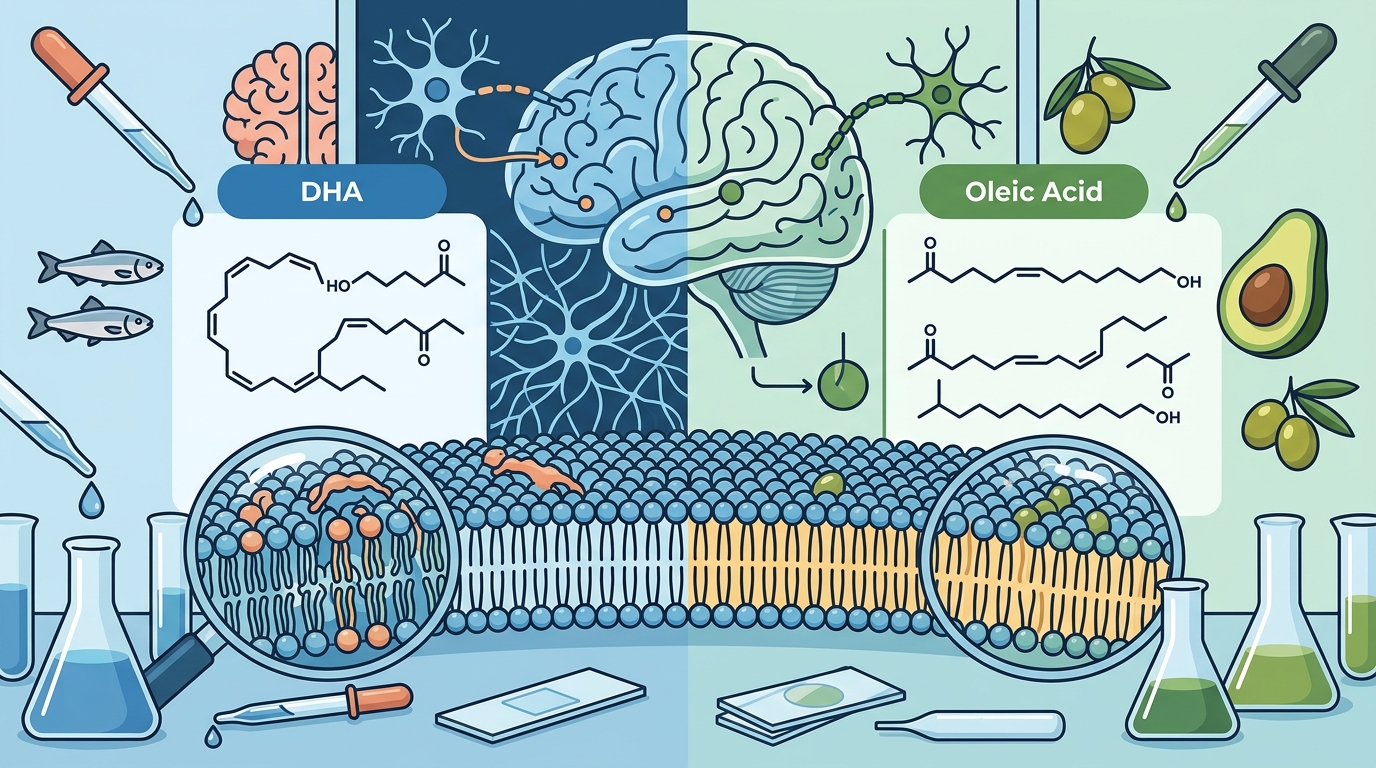
The table above highlights the distinct roles of each fatty acid. DHA is essential for the physical structure of the neuron, while Oleic Acid provides the stability needed to protect that structure. Neither is inherently "better" than the other; rather, they work in tandem to support optimal brain function.
For those interested in advanced lipid biology, the balance between these fatty acids is critical. An imbalance can lead to increased oxidative stress and reduced cognitive performance. This is why comprehensive testing and targeted supplementation are often recommended by lipid experts. (Uncovering the Lipid)
Monitoring Your Lipid Profile
One of the most effective ways to understand your personal lipid needs is through advanced biomarker testing. Standard blood tests often do not provide a detailed enough picture of your membrane fatty acid composition.
ProdromeScan™ is a blood test kit designed to measure plasmalogen levels and other key lipid biomarkers. By understanding your current lipid profile, you can make more informed decisions about supplementation. For example, if your DHA levels are low, you might consider targeted DHA supplementation. If your plasmalogen levels are low, you might explore plasmalogen supplements like ProdromeGlia™.
Testing allows you to move beyond generic health advice and into personalized lipid management. This approach is particularly valuable for individuals concerned about age-related cognitive decline or those looking to optimize their brain health proactively. The data from these tests can guide you in choosing the right balance of DHA, Oleic Acid, and other essential lipids.
Key Takeaways
- DHA is a structural omega-3 fatty acid that is critical for neuronal membrane fluidity and signal transmission.
- Oleic Acid is a monounsaturated omega-9 fatty acid that provides stability and protects against oxidative stress.
- Plasmalogens are specialized phospholipids that protect cell membranes and are abundant in the brain.
- Prodrome Science has over 30 years of research focused on lipid biology and plasmalogen supplementation.
- Advanced biomarker testing like ProdromeScan™ can help identify specific lipid deficiencies.
- Balance is key; both DHA and Oleic Acid play complementary roles in maintaining brain health.
- Targeted nutrition is more effective than general supplementation for optimizing lipid profiles.
Frequently Asked Questions
What is the main difference between DHA and Oleic Acid?
DHA is an omega-3 polyunsaturated fatty acid that primarily supports neuronal structure and signal transmission. Oleic Acid is an omega-9 monounsaturated fatty acid that helps maintain membrane stability and fluidity.
Can Oleic Acid replace DHA for brain health?
No, Oleic Acid cannot replace DHA. They serve different functions. DHA is essential for the physical structure of the neuron, while Oleic Acid provides stability. Both are needed for optimal brain health.
What are plasmalogens?
Plasmalogens are a specific class of phospholipids that are abundant in the brain and heart. They protect cell membranes from oxidative stress and are crucial for maintaining membrane integrity.
How can I test my plasmalogen levels?
You can use the ProdromeScan™ blood test kit to measure your plasmalogen levels and other key lipid biomarkers. This provides a detailed picture of your lipid profile.
Is DHA susceptible to oxidation?
Yes, DHA is highly susceptible to oxidation due to its polyunsaturated nature. This is why it is important to maintain a balance with antioxidants and stable fatty acids like Oleic Acid.
What is Prodrome Science?
Prodrome Science is a company dedicated to advancing the understanding of lipid biology. They offer plasmalogen supplements, testing kits, and educational resources for health professionals and individuals.
Why is membrane fluidity important for the brain?
Membrane fluidity allows receptors to function optimally and facilitates signal transmission between neurons. Reduced fluidity can lead to cognitive decline and reduced brain efficiency.
Take the Next Step
Understanding the nuances of lipid biology is the first step toward optimizing your brain health. Whether you are interested in learning more about plasmalogens or exploring targeted supplementation, Prodrome Science offers the resources and expertise to guide you. Visit the Prodrome homepage to explore their range of plasmalogen supplements and blood test kits. For health professionals, the Prodrome Science blog provides in-depth articles on lipid biology. You can also shop all plasmalogens to find the right product for your needs. To get started with personalized lipid management, consider learning more about their science or accessing the customer hub for support.